
Key Takeaways
- Liability vs full coverage car insurance comes down to what you want your policy to protect: other people and their property, your vehicle, or both.
- Liability insurance generally pays for covered injuries and property damage you cause to others, while collision and comprehensive coverage can help protect your own vehicle.
- Full coverage vs liability insurance is not always an either-or decision. Your vehicle’s value, financing, driving habits, budget, and ability to absorb an unexpected loss can all influence the choice.
- If you still have an auto loan, your lender may require collision and comprehensive coverage.
- Before deciding when to drop full coverage insurance, compare the cost of the coverage with the vehicle’s current value and what you could reasonably afford to pay after a loss.
Choosing car insurance can feel like comparing two simple options: liability or full coverage. In practice, the decision is more nuanced.
The right policy depends on what you need to protect and how much financial risk you are comfortable taking. It also helps to understand that “full coverage” is commonly used as shorthand for a policy that includes liability plus physical-damage coverages such as collision and comprehensive; it is not a single standardized coverage that pays for everything.
What Is Liability Car Insurance?
So, what is liability car insurance?
Liability coverage is designed to help pay for certain injuries and property damage you cause to other people in a covered accident. In Texas, drivers are required to have a way to pay for accidents they cause, and most do so by purchasing liability insurance. The state’s minimum financial responsibility limits are 30/60/25: $30,000 for each injured person, up to $60,000 per accident, and $25,000 for property damage.
Those are minimums, not necessarily the amount of protection that makes sense for every driver.
If a covered claim exceeds your policy limits, you may be responsible for the remaining amount. That is one reason some drivers choose liability limits above the state minimum.
What Does Full Coverage Car Insurance Cover?
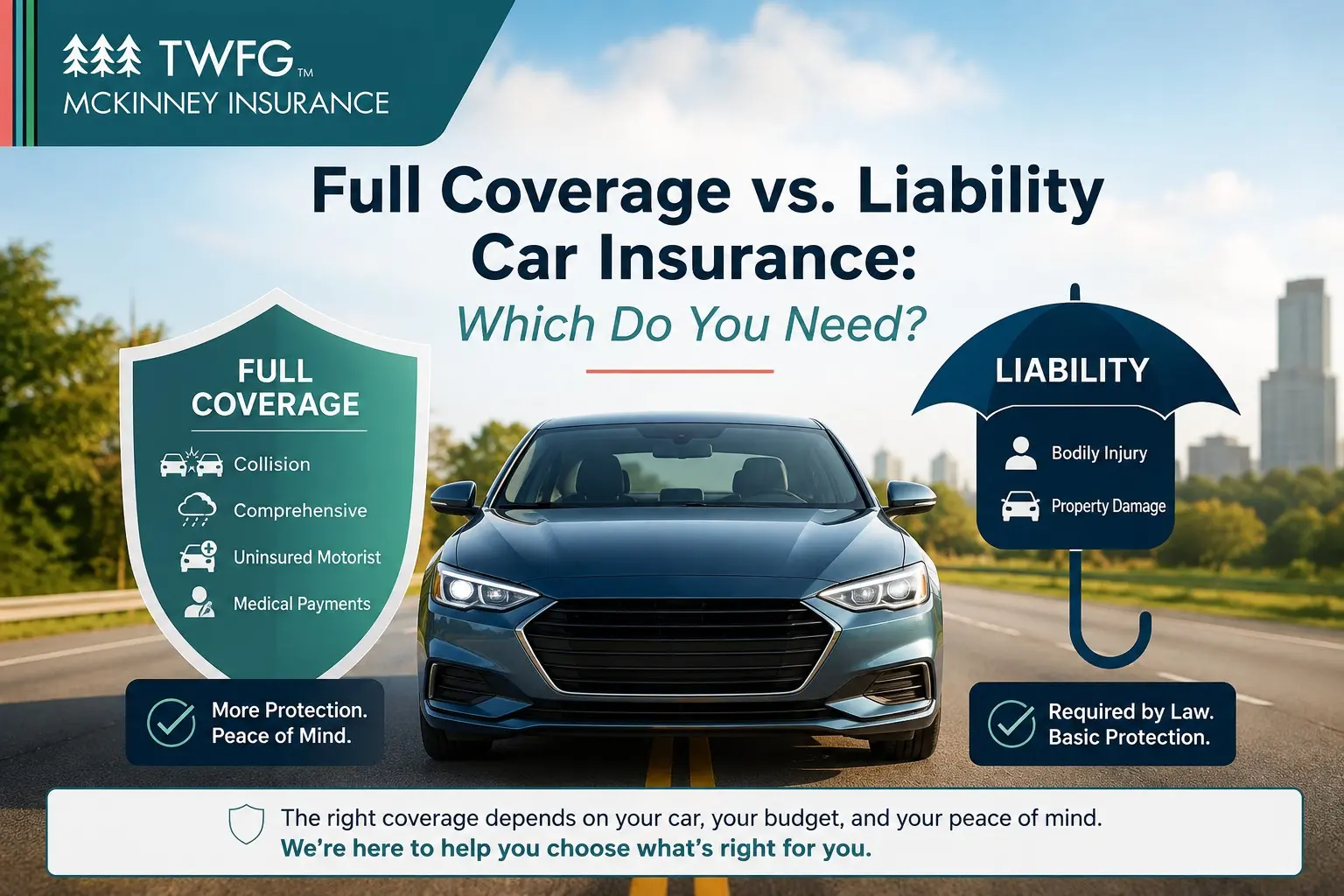
When people ask what does full coverage car insurance cover, they are usually referring to liability coverage combined with collision and comprehensive coverage.
Collision coverage can help pay to repair or replace your vehicle after a covered collision. Comprehensive coverage generally applies to covered losses that are not caused by a collision, such as theft, fire, flood, vandalism, or certain weather-related damage.
Depending on the policy, drivers may also have options such as uninsured/underinsured motorist coverage, medical payments coverage, personal injury protection, and rental reimbursement. These are separate coverage choices and should not automatically be assumed to be included simply because someone calls a policy “full coverage.”
Liability vs. Full Coverage Car Insurance: What Is the Difference?
The easiest way to think about the difference between liability and full coverage is to consider whose financial loss is being protected.
Liability coverage: Primarily protects you financially when you are responsible for covered injuries or property damage to others.
Collision coverage: Helps protect your own vehicle from covered collision damage.
Comprehensive coverage: Helps protect your vehicle from covered non-collision losses.
This distinction matters after an accident. If another driver damages your car and you only carry liability coverage, your own policy generally will not pay to repair your vehicle under liability coverage. Collision coverage may provide that protection, subject to the policy terms and deductible.
Which Type of Coverage Makes Sense for Your Car?
There is no universal answer.
A newer or higher-value vehicle may make the cost of protecting the vehicle easier to justify. If you rely heavily on your car and would struggle to replace it after a major loss, broader coverage may also provide valuable financial protection.
On the other hand, someone driving an older vehicle with a relatively low market value may decide that paying for collision and comprehensive coverage no longer fits their priorities.
Your deductible matters, too. A higher deductible can reduce the premium, but it also means taking on more out-of-pocket expense when you file a covered claim.
Making the Right Insurance Decision
When choosing between full coverage vs liability insurance, you need to keep in mind several factors including the protection you are getting for your money and at what potential cost of risk.
Start by reviewing your current policy. Look at the liability limits, deductibles, collision and comprehensive coverage, exclusions, and optional protections. Then consider what you could realistically afford if your vehicle were damaged or stolen tomorrow.
At McKinney Insurance Agency, the focus is on explaining coverage options in straightforward terms and helping clients compare policies based on their individual needs.
FAQs
At what point is full coverage not worth it?
There is no universal cutoff. It may be worth reconsidering when the cost of collision and comprehensive coverage, combined with the deductible, becomes difficult to justify relative to the vehicle’s current value and your ability to replace it.
How much is full coverage normally?
There is no standard price for full coverage. Premiums can vary based on factors such as the driver, vehicle, location, coverage limits, deductible, driving history, and insurer. Comparing quotes using the same coverage levels provides a more useful comparison than relying on an average price.
What does liability not cover?
Liability coverage generally does not pay to repair your own vehicle after an accident you cause. Collision coverage may provide protection for covered collision damage to your vehicle, while comprehensive coverage addresses certain covered non-collision losses.
Do I really need liability insurance?
If you drive in Texas, you must have a way to demonstrate financial responsibility for accidents you cause, and most drivers meet this requirement through liability insurance. The state requires minimum liability limits, although choosing higher limits may be appropriate depending on your circumstances.